VERTEX OF A 3D OBJECT
Definition Of Vertex Of A 3D Object
In a three-dimensional object, Vertex is the point where two edges intersect or meet.
More About Vertex of a Polygon
The number of vertices in a prism is given by 2n, where n is the number of sides of the base. For example, if the base of the prism is a hexagon, then the number of vertices in the hexagonal prism is 2 × 6 = 12
Video Examples: Math - 3D Shapes Vertices, Faces, and Edges
Example of Vertex of a 3D Object
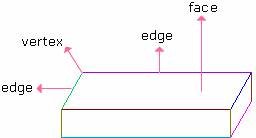
The edges are the line segments where the faces intersect. The vertex is the point(s) where the edges intersect.
Solved Example on Vertex of a 3D Object
Ques: How many vertices does a cube have?

Choices:
A. 12
B. 8
C. 6
D. 10
Correct Answer: B
Solution:
Step 1: There are 12 edges that are formed by joining 8 vertices in the cube.
Step 2: So, a cube has 8 vertices.
Quick Summary
- A vertex is a corner point on a 3D shape.
- Edges meet at a vertex.
- The number of vertices can be determined by the shape of the object.
🍎 Teacher Insights
Use physical models to help students visualize vertices. Start with simple shapes like cubes and move to more complex prisms and pyramids.🎓 Prerequisites
- Basic Geometry
- Understanding of 2D shapes
- Spatial Reasoning
Check Your Knowledge
Q1: How many vertices does a cube have?
Q2: A triangular prism has how many vertices?
Frequently Asked Questions
Q: What is the difference between a vertex, an edge, and a face?
A: A vertex is a point, an edge is a line segment connecting two vertices, and a face is a flat surface bounded by edges.
Q: How do I find the number of vertices in a prism?
A: The number of vertices in a prism is given by 2n, where n is the number of sides of the base.