VARIANCE
Definition Of Variance
Variance is a statistical measure that tells us how measured data vary from the average value of the set of data.
In other words, variance is the mean of the squares of the deviations from the arithmetic mean of a data set.
More About Variance
Variance is the square of the standard deviation.
The formula for variance is

Video Examples: What is Variance in Statistics?
Solved Example on Variance
Ques: Find the variance of the data set {1, 2, 3, 4, 10}.
Choices:
A. 10
B. 9
C. 8
D. 7
Correct Answer: A
Solution:
tep 1: The mean of the data set {1, 2, 3, 4, 10} is 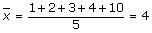 [Use the formula for mean.]
Step 2: The standard deviation of the data set is
 [Use the formula for mean.]
Step 3: 
Step 4: The variance of the data set is  [Substitute
  ]
]
Quick Summary
- Variance measures the spread of data points in a data set.
- It is the square of the standard deviation.
- A higher variance indicates greater variability.
🍎 Teacher Insights
Emphasize the practical applications of variance, such as understanding risk in investments or variability in manufacturing processes. Use visual aids to demonstrate the spread of data.🎓 Prerequisites
- Mean
- Standard Deviation
- Data Sets
Check Your Knowledge
Q1: What is the variance of the data set {1, 2, 3, 4, 5}?
Q2: If the standard deviation of a dataset is 3, what is the variance?
Frequently Asked Questions
Q: What is the relationship between variance and standard deviation?
A: Variance is the square of the standard deviation. Standard deviation is the square root of the variance.
Q: How is variance affected by outliers?
A: Outliers can significantly increase the variance of a data set because they increase the squared deviations from the mean.