SCALE FACTOR
Definition Of Scale Factor
The ratio of any two corresponding lengths in two similar geometric figures is called as Scale Factor.
The ratio of the length of the scale drawing to the corresponding length of the actual object is called as Scale Factor.
More About Scale Factor
A scale factor is a number used as a multiplier in scaling.
A scale factor is used to scale shapes in 1, 2, or 3 dimensions.
Scale factor can be found in the following scenarios:
1. Size Transformation: In size transformation, the scale factor is the ratio of expressing the amount of magnification.
2. Scale Drawing: In scale drawing, the scale factor is the ratio of measurement of the drawing compared to the measurement of the original figure.
3. Comparing Two Similar Geometric Figures: The scale factor when comparing two similar geometric figures, is the ratio of lengths of the corresponding sides.
Video Examples: Proportions, Triangles, MissingSides, Scale Factors
Example of Scale Factor
ABCD and PQRS are similar polygons. Then the scale factor of polygon ABCD to polygon
PQRS is the ratio of the lengths of the corresponding sides.
Scale factor = BC:QR = 3:8.
Solved Example on Scale Factor
Ques: Find the scale factor from the larger rectangle to the smaller rectangle, if the two rectangles are similar.
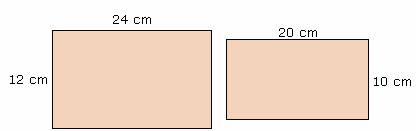
Choices:
A. 5:1
B. 5:6
C. 6:5
D. 6:7
Correct Answer: B
Solution:
Step 1: If we multiply the length of one side of the larger rectangle by the scale factor we get the length of the corresponding side of the smaller rectangle.
Step 2: Dimension of larger rectangle × scale factor = dimension of smaller rectangle
Step 3: 24 × scale factor = 20 [Substitute the values.]
Step 4: Scale factor = 20/24 [Divide each side by 24.]
Step 5: Scale factor =5/6= 5:6 [Simplify.]
Therefore, scale factor from the larger rectangle to the smaller rectangle is 5:6.
Quick Summary
- Scale factor is a multiplier used in scaling.
- It's the ratio of corresponding lengths in similar figures.
- Used in size transformations and scale drawings.
🍎 Teacher Insights
Use hands-on activities with manipulatives (e.g., pattern blocks, grid paper) to help students visualize scaling. Emphasize the importance of identifying corresponding sides correctly. Provide real-world examples of scale drawings, such as maps and blueprints.🎓 Prerequisites
- Ratios
- Proportions
- Basic Geometric Shapes
Check Your Knowledge
Q1: Two similar rectangles have lengths of 10cm and 15cm. What is the scale factor of the larger rectangle to the smaller rectangle?
Q2: A square with side length 4 is scaled by a factor of 2. What is the side length of the new square?
Frequently Asked Questions
Q: What does a scale factor of 1 mean?
A: A scale factor of 1 means the figure remains the same size; it's a congruence transformation.
Q: Can a scale factor be a fraction?
A: Yes, a scale factor can be a fraction. A fraction less than 1 indicates a reduction in size.