RATIONAL EQUATION
Definition Of Rational Equation
A rational equation is an equation containing rational expressions.
More About Rational Equation
Rational Expression: A rational expression is an expression of the form  where Pand Q are nonzero polynomials.
Rational Function: A function written, as a quotient of polynomials is a rational function.
That is, if p(x) and q(x) are polynomial functions and q(x) ≠ 0, then  is called rational function.
Video Examples: Solving Rational Equations
Examples of Rational Equation
The following are examples of rational equation.
 ,
,  ,
, 
Solved Example on Rational Equation
Ques: Solve the rational equation
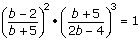
Choices:
A. 
B. b = -5
C. b = 2
D. b = 3
Correct Answer: D
Solution:
Step 1: [Rational equation.]
Step 2: If b = - 5 and b = 2, then the denominators value becomes zero. So, the replacement set is all real numbers except - 5, 2. [Simplify.]
Step 3: 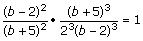 [Simplify.]
Step 4:
Step 5: b + 5 = 8b - 16
Step 6: b = 3 [Solve for b.]
Step 7: So, the solution is b = 3.
Quick Summary
- Rational equations involve fractions with variables in the numerator and/or denominator.
- Solving rational equations often involves finding a common denominator and clearing fractions.
- It is crucial to check for extraneous solutions when solving rational equations.
🍎 Teacher Insights
Emphasize the importance of checking for extraneous solutions. Use visual aids to demonstrate the process of finding a common denominator. Provide plenty of practice problems with varying levels of difficulty.🎓 Prerequisites
- Polynomials
- Rational Expressions
- Solving Equations
Check Your Knowledge
Q1: Solve the rational equation: 1/x = 2/(x+1)
Frequently Asked Questions
Q: What is an extraneous solution?
A: An extraneous solution is a value that satisfies the transformed equation but not the original rational equation. It often arises when multiplying both sides of an equation by an expression that can be zero.
Q: Why do we need to find a common denominator?
A: A common denominator is needed to combine rational expressions through addition or subtraction, just like with regular fractions.