PARALLELOGRAM RULE
Definition Of Parallelogram Rule
Parallelogram Rule provides the means to perform vector addition of two vectors in two-dimensional space.
More About Parallelogram Rule
It is most easily understood in the two-dimensional model.
It is also called parallelogram law.
Examples of Parallelogram Rule
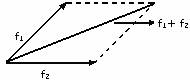
Suppose two persons are pulling a load with a force f 1 and f 2 in two different directions from a fixed point. Then these forces can be represented as two sides of a parallelogram. By completing the parallelogram and using the parallelogram rule, the diagonal represents the sum of the two original forces f 1 + f 2.
Video Examples: The Parallelogram Law : Parallelograms & Math
Solved Example on Parallelogram Rule
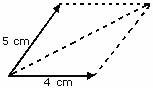
Ques: Using the Parallelogram rule, find the value of the resultant vector for the given figure.
Choices:
A. 9 cm
B. 20 cm
C. 10 cm
D. 1 cm
Correct Answer: A
Solution:
Step 1: Using the parallelogram rule, if a and b are the vectors that represent the sides of the parallelogram, then the resultant vector is by the diagonal whose value is given as a + b.
Step 2: Then, substituting the values of a and b as 5 cm and 4 cm respectively, the resultant vector is given as (5 + 4) cm = 9 cm.
Step 3: Hence the value of resultant vector is 9 cm.
Quick Summary
- The parallelogram rule is a graphical method for vector addition.
- The resultant vector is the diagonal of the parallelogram formed by the two vectors.
- The magnitude of the resultant vector can be calculated using the law of cosines.
🍎 Teacher Insights
Emphasize the geometric interpretation of vector addition. Use physical examples like forces acting on an object to illustrate the concept. Encourage students to draw accurate diagrams to aid their understanding.🎓 Prerequisites
- Basic vector concepts
- Geometry of parallelograms
Check Your Knowledge
Q1: Two forces, 3N and 4N, act on an object at an angle of 90 degrees to each other. What is the magnitude of the resultant force?
Q2: Which geometrical shape is fundamental to the parallelogram rule?
Frequently Asked Questions
Q: When is the parallelogram rule most useful?
A: The parallelogram rule is most useful for adding two vectors graphically, especially when the angle between them is not 0 or 180 degrees.
Q: How does the parallelogram rule relate to the triangle rule of vector addition?
A: The triangle rule is essentially half of the parallelogram. Both methods yield the same resultant vector.