OBLIQUE
Definition Of Oblique
The lines that are drawn at an angle (not 900) to the horizon are called Oblique Lines.
More About Oblique
Oblique lines are neither vertical nor horizontal.
Example of Oblique
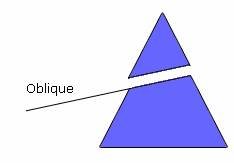
The above figure shows a triangle being cut by an oblique line.
Video Examples: How to Solve Oblique Word Problems
Solved Example on Oblique Prism
Ques: Identify the oblique lines from the figures shown.
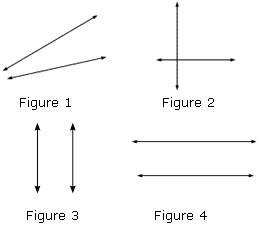
Choices:
A. Figure 1
B. Figure 2
C. Figure 3
D. Figure 4
Correct Answer: A
Solution:
Step 1: Here, the lines in figure 1 are neither vertical nor horizontal.
Step 2: So, the lines in figure 1 are oblique lines.
Quick Summary
- Oblique lines are neither vertical nor horizontal.
- They form angles other than 90 degrees with the horizon.
🍎 Teacher Insights
Use real-world examples like slanted roofs, diagonal stripes, or leaning objects to illustrate oblique lines. Have students identify oblique lines in their surroundings.🎓 Prerequisites
- Basic understanding of lines
- Knowledge of angles
- Familiarity with horizontal and vertical lines
Check Your Knowledge
Q1: Which of the following describes an oblique line?
Q2: Which of the following is NOT an example of an oblique line?
Frequently Asked Questions
Q: What is the difference between oblique and perpendicular lines?
A: Perpendicular lines intersect at a 90-degree angle, while oblique lines intersect at any other angle.
Q: Can oblique lines be parallel?
A: No, parallel lines never intersect. Oblique lines are defined by their angle relative to horizontal/vertical, not by their relationship to other lines.