NUMBER SENSE
Definition of Number Sense
Number Sense is the ability to recognize numbers, identify their relative values, and understand how to use them in a variety of ways, such as counting, measuring, or estimating.
More about Number Sense
Number sense includes number meanings, number relationships, number size, and the relative effect of operations on numbers.
Examples of Number Sense
The number sense strategy helps one to find the sum of 35 + 24 in this way: 30 + 20 = 50; 5 + 4 = 9; 50 + 9 = 59.
The strategy to round 57 to the nearest ten is obtained by estimating whether 57 is closer to 50 or 60. As 57 is nearer to 60, the estimated value to the nearest ten of 57 is 60.
Solved Example on Number Sense
Arrange these decimal numbers in order from the least to the greatest.
0.34, 0.47, 0.21, 0.58
Choices:
A. 0.21 < 0.34="">< 0.47=""><>
B. 0.34 < 0.21=""> 0.47 <>
C. 0.58 > 0.47 > 0.34 > 0.21
D. 0.47 > 0.34 > 0.21 <>
Correct Answer: A
Solution:
Step 1: Use the number line
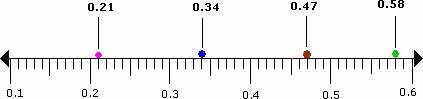
Step 2: The numbers are arranged in order from the least to the greatest in the number line.
Step 3: So, 0.21 < 0.34="">< 0.47=""><>
Related Terms for Number Sense
Counting
Decimal
Estimate
Measure
Number Line
Operation
Place Value
Quick Summary
- Number sense includes understanding number meanings.
- It also encompasses number relationships and sizes.
- It involves understanding the effects of operations on numbers.
🍎 Teacher Insights
Use visual aids like number lines and manipulatives to help students develop number sense. Encourage estimation and mental math strategies.🎓 Prerequisites
- Counting
- Basic Arithmetic
Check Your Knowledge
Q1: Which number is greater: 35 or 24?
Q2: Round 57 to the nearest ten.
Frequently Asked Questions
Q: What does number sense mean?
A: It's the ability to understand numbers, their relationships, and how they work.
Q: Why is number sense important?
A: It builds a strong foundation for more advanced math concepts.