NTH ROOT
Definition Of NthRoot
In an = b, where a and b are real numbers and n is a positive integer, a is an nth root of b. It can also be written as 
Examples of NthRoot
Following are some examples on Nth Root.
3 is the fouth root of 81. That is, 3 has to be multiplied by itself 4 times to give 81
2 is the sixth root of 64. That is, 2 has to be multiplied by itself 4 times to give 64
4 is the square root of 16.
5 is the cube root of 125.
Video Examples: Simplifying The Nth Root
Solved Example on NthRoot
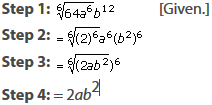
Ques: Find: 
Choices:
A. 2ab2
B. 2a2b2
C. 2a6b2
D. 2a2b
Correct Answer: A
Solution:
Quick Summary
- The nth root of a number 'b' is a value 'a' that, when raised to the power of 'n', equals 'b'.
- The index 'n' indicates the root being taken (e.g., square root, cube root).
- Finding the nth root is the inverse operation of raising a number to the nth power.
🍎 Teacher Insights
Use visual aids and real-world examples to help students grasp the concept of nth roots. Emphasize the inverse relationship between exponents and radicals. Provide ample practice problems with varying levels of difficulty.🎓 Prerequisites
- Exponents
- Multiplication
- Basic Algebra
Check Your Knowledge
Q1: What is the fourth root of 81?
Q2: Simplify: \sqrt[3]{125}
Frequently Asked Questions
Q: What is the difference between a square root and a cube root?
A: A square root (n=2) is a value that, when multiplied by itself, equals the original number. A cube root (n=3) is a value that, when multiplied by itself twice, equals the original number.
Q: Can I take the nth root of a negative number?
A: If 'n' is even, you can only take the nth root of a non-negative number within the realm of real numbers. If 'n' is odd, you can take the nth root of a negative number.