LAW OF COSINES
Definition Of Law Of Cosines
Law of Cosines is an equation relating the lengths of the sides of a cosine of one of its angles.
More About Law of Cosines
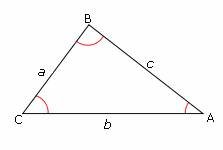
For any triangle ABC, where a, b, and c are the lengths of the sides opposite to the angles A, B, and C respectively, the Law of cosines states that:
a2 = b2+ c2- 2bc cos A
b2 = a2 + c2 - 2ac cos B
c2 = a2 + b2 - 2ab cos C
Law of cosines is also called as cosine rule or cosine formula.
Video Examples: Law of Cosines
Example of Law of Cosines
The figure below shows two of the six Law of Cosiness of a cube In triangle ABC, if a = 19, b = 12, and c = 10 are the lengths of the sides opposite to the angles A, B, and C respectively, then, by using law of cosines, the measure of angle A can be obtained this way:
a2 = b2+ c2- 2bc cos A
Cos A = b2+ c2 - a2/ 2bc
Cos A = 122 + 102 - 192/ 2(12) (10)
Cos A = - 0.4875
∠ A = 119°
Solved Example on Law of Cosines
Ques: In â–³DEF, if angle D = 46°, f = 10, and e = 17, then find the length of d to two significant digits
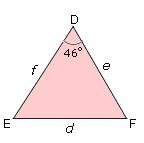
Choices:
A. 27
B. 20
C. 12
D. 25
Correct Answer: C
Solution:
Step 1: d2 = 172 + 102 - 2 (17) (10) cos 46° [Use law of cosines: d2 = e2+ f2- 2ef cos D.]
Step 2: d2 ~ 152.816154
Step 3: d = 12, to two significant digits. [Simplify.]
Quick Summary
- The Law of Cosines relates the sides and angles of any triangle.
- It can be used to find the missing side when two sides and the included angle are known (SAS).
- It can be used to find a missing angle when all three sides are known (SSS).
- It is a generalization of the Pythagorean Theorem.
🍎 Teacher Insights
Emphasize the importance of correctly labeling the sides and angles of the triangle. Provide plenty of practice problems with varying levels of difficulty. Encourage students to draw diagrams to visualize the problem.🎓 Prerequisites
- Pythagorean Theorem
- Trigonometric Ratios (Sine, Cosine, Tangent)
- Algebraic Manipulation
Check Your Knowledge
Q1: In triangle ABC, if a = 7, b = 5, and angle C = 60°, find the length of side c.
Q2: In triangle XYZ, if x = 8, y = 5, and z = 7, find the measure of angle Z.
Frequently Asked Questions
Q: When should I use the Law of Cosines instead of the Law of Sines?
A: Use the Law of Cosines when you have Side-Angle-Side (SAS) or Side-Side-Side (SSS) information. Use the Law of Sines when you have Angle-Side-Angle (ASA) or Angle-Angle-Side (AAS) information.
Q: Can the Law of Cosines be used for right triangles?
A: Yes, it can. In a right triangle, one angle is 90 degrees, and the cosine of 90 degrees is 0. The Law of Cosines then simplifies to the Pythagorean Theorem.