LATERAL SURFACE AREA
Definition Of Lateral Surface Area
Lateral surface area in a solid is the sum of the surface areas of all its faces excluding the base of the solid.
More About Lateral Surface Area
Lateral surface area of a cube = 4b2, where b is the base of a cube
Lateral surface area of a sphere is 4πr2, where r is the radius of the sphere.
Lateral surface area of a cone = π × r × l, where r and l are the radius and slant height of the cone
Lateral surface area of a cylinder = 2πrh, where r is the radius and h is the height of the cylinder
Lateral surface area of the right triangular pyramid = 3 × area of lateral faces
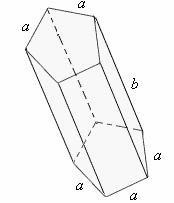
Lateral surface area of a pentagonal prism = 5 × area of each rectangle
Example of Lateral Surface Area
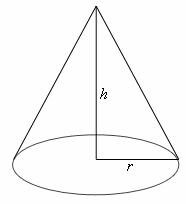
Let's find out the lateral surface of a cone that has a base radius (r) of length 6 yd and a height (h) of 8 yd.
Lateral surface area of the cone = πrl
Slant height of the cone, l = [l =
[l = .]
.]
= 10 yd
Lateral surface area = 3.14 × 6 × 10 [As r = 6 and h = 10]
= 188.4
So, the lateral surface area of the cone = 188.4 sq yd.
Video Examples: Lateral and Surface Areas of Prisms
Solved Example on Lateral Surface Area
Ques: Find the lateral surface area of a pentagonal prism, if a = 5 cm and b = 14 cm.
Choices:
A. 330 cm2
B. 95 cm2
C. 350 cm2
D. 370 cm2
Correct Answer: C
Solution:
Step 1: In the given figure, the base of the prism is a regular pentagon.
Step 2: All five rectangles are congruent.
Step 3: Lateral surface area of the prism = 5 × area of each rectangle
Step 4: = 5 × 5 × 14 [Substitute the values.]
Step 5: = 350 [Simplify.]
Step 6: Lateral surface area of the pentagonal prism = 350 CM∧2.
Quick Summary
- Lateral surface area excludes the base(s).
- Different formulas apply for different shapes (cube, sphere, cone, cylinder, prism, pyramid).
- Units are in square units (e.g., sq yd, cm²).
🍎 Teacher Insights
Use physical models of the shapes to help students visualize the lateral faces. Emphasize the difference between lateral and total surface area. Provide plenty of practice problems.🎓 Prerequisites
- Area of basic shapes (squares, rectangles, triangles, circles)
- Volume
- Pythagorean theorem
Check Your Knowledge
Q1: What is the lateral surface area of a cube with a base of 5 cm?
Q2: The lateral surface area of a cylinder is 2πrh. If r = 3 and h = 4, what is the LSA?
Frequently Asked Questions
Q: What is the difference between lateral surface area and total surface area?
A: Lateral surface area excludes the area of the base(s), while total surface area includes it.
Q: How do I find the lateral surface area of a composite figure?
A: Break the figure down into simpler shapes, find the lateral surface area of each shape, and add them together, excluding any shared base areas.