INCREASING FUNCTION
Definition Of Increasing Function
A function f is said to be increasing if f(a) > f(b) when a > b.
More About Increasing Function
The graph of an increasing function always goes up from left to right.
A function is increasing at all the points where its derivative is positive.
Video Examples: Increasing-Decreasing Functions
Example of Increasing Function
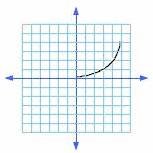
In figure, the curve is going up from left to right. Hence, the function is said to be increasing.
Solved Example on Increasing Function
Ques: Find the interval in which f(x) = 3x? - 54x2 + 14 increases.
Choices:
A. (- 3, 3)
B. (0, 8)
C. (0, 3) U (3, 8)
D. (- 3, 0) U (3, 8)
Correct Answer: D
Solution:
Step 1: Here f(x) = 3x? - 54x2 + 14 [Given function.]
Step 2: f '(x) = 12x? - 108x [Differentiate.]
Step 3: = 12x (x2 - 9) [Factorize.]
Step 4: = 12x (x - 3) (x + 3) [Factorize.]
Step 5: For x (x + 3)(x - 3) > 0, f ' (x) > 0
Step 6: For x ε (- 3, 0) U (3, 8), f ' (x) > 0 [Solve the inequality.]
Step 7: So, f(x) increases in (- 3, 0) U (3, 8).
Quick Summary
- The graph of an increasing function always goes up from left to right.
- A function is increasing at all the points where its derivative is positive.
🍎 Teacher Insights
Use visual aids like graphs to illustrate the concept. Emphasize the connection between the derivative and the slope of the tangent line.🎓 Prerequisites
- Basic Algebra
- Understanding of Functions
- Derivatives
Check Your Knowledge
Q1: Find the interval in which f(x) = 3x^4 - 54x^2 + 14 increases.
Q2: If f'(x) < 0, the function f(x) is:
Frequently Asked Questions
Q: How do I find the intervals where a function is increasing?
A: Find the derivative of the function, set it greater than zero, and solve the inequality.
Q: What is the difference between increasing and strictly increasing?
A: A function is strictly increasing if f(a) > f(b) whenever a > b. A function is increasing if f(a) >= f(b) whenever a > b.