IMAGE
Definition Of Image
The new position of a point, a line, a line segment, or a figure after a transformation is called its image.
Example of Image
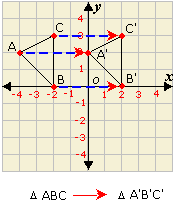
In the example shown below, triangle A'B'C is the image of triangle A'B'C, after translation.
Points A'B'C are the images of points A, B, and C respectively.
The line segments A'B', B'C', and A'C' are the images of the original line segments AB, BC, and AC respectively.
Video Examples: Geometry: iCoachMath Works
Solved Example on Image
Ques: What would be the image of a polygon reflected over a line with respect to the original polygon?
Choices:
A. Similar
B. Congruent
C. Increase in size
D. None of the above
Correct Answer: B
Solution:
Step 1: A reflection flips the figure across a line. The new figure is a mirror image of the original figure.
Step 2: So, the image of the polygon reflected over a line is congruent with respect to the original polygon.
Quick Summary
- An image is the result of a transformation applied to a figure.
- The image retains properties dependent on the type of transformation (e.g., congruence for reflections).
- Points, lines, and figures all have corresponding images after a transformation.
🍎 Teacher Insights
Use visual aids and interactive software to demonstrate transformations and their resulting images. Emphasize the distinction between different types of transformations and their effects on size and orientation.🎓 Prerequisites
- Coordinate plane
- Basic geometric shapes (points, lines, polygons)
- Transformations (translation, reflection, rotation)
Check Your Knowledge
Q1: What is the image of a polygon reflected over a line with respect to the original polygon?
Frequently Asked Questions
Q: Is the image always the same size as the original?
A: Not always. Transformations like dilations change the size. Transformations like translations, rotations, and reflections do not change the size and maintain congruence.
Q: How do I find the image of a point after a transformation?
A: Apply the rules of the transformation to the coordinates of the point.