ICOSAHEDRON
Definition Of Icosahedron
An Icosahedron is a polyhedron with 20 faces which are all equilateral triangles.
More About Icosahedron
It has 20 faces, 30 edges and 12 vertices.
The surface area of an icosahedron is given by  , where a is the edge length of the icosahedron.
The volume of an icosahedron is given by  , where a is the edge length of the icosahedron.
Video Examples: Math Sculpture - Icosahedron I
Example of Icosahedron
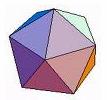
The figure below shows two of the six Icosahedrons of a cube
Solved Example on Icosahedron
Ques: Identify an icosahedron from the following figures.
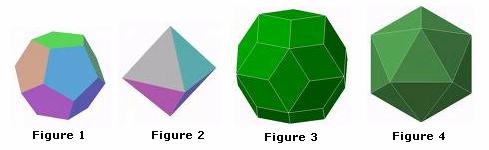
Choices:
A. Figure 3
B. Figure 2
C. Figure 4
D. Figure 1
Correct Answer: C
Solution:
Step 1: An icosahedron has 20 faces, 30 edges and 12 vertices with equilateral triangles.
Step 2: Here, Figure 4 is an icosahedron.
Quick Summary
- Icosahedron has 20 faces, 30 edges and 12 vertices.
- Faces are equilateral triangles.
🍎 Teacher Insights
Use physical models to demonstrate the icosahedron. Relate it to real-world examples.🎓 Prerequisites
- Triangle Properties
- Basic Geometry
- Spatial Reasoning
Check Your Knowledge
Q1: Which of the following is an icosahedron?
Frequently Asked Questions
Q: How many faces does an icosahedron have?
A: An icosahedron has 20 faces.
Q: What shape are the faces of an icosahedron?
A: The faces are equilateral triangles.