FUNDAMENTAL THEOREM OF ARITHMETIC
Definition Of Fundamental Theorem Of Arithmetic
Fundamental Theorem of Arithmetic states that every natural number greater than 1 can be written as a unique product of prime numbers.
More About Fundamental Theorem of Arithmetic
Fundamental theorem of arithmetic is also called as Unique Factorization Theorem.
Video Examples: Fundamental Theorem of Arithmetic centered cubic fcc
Example of Fundamental Theorem of Arithmetic
6 can be written as 2 × 3, where 2 and 3 are prime numbers.
15 can be written as 3 × 5, where 3 and 5 are prime numbers.
20 can be written as 22 × 5, where 2 and 5 are prime numbers.
Solved Example on Fundamental Theorem of Arithmetic
Ques: Express the prime factorization of the number 72 using exponents.
Choices:
A. 23 × 32
B. 23 × 31
C. 22 × 33
D. 2 × 32
Correct Answer: A
Solution:
Step 1:
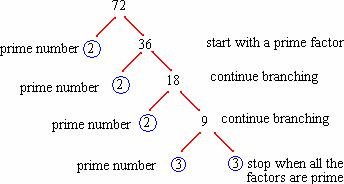
Step 2: The prime factorization of 72 = 2 × 2 × 2 × 3 × 3.
Step 3: 2 × 2 × 2 × 3 × 3 = 23 × 32 [Convert product form to exponential form.]
Step 4: The prime factorization of 72 in exponential form is 23 × 32.
Quick Summary
- Every integer > 1 can be expressed as a product of primes.
- This prime factorization is unique, except for the order of the factors.
🍎 Teacher Insights
Emphasize the importance of prime factorization in various mathematical concepts such as simplifying fractions, finding the greatest common divisor (GCD), and the least common multiple (LCM). Use visual aids like factor trees to help students understand the process.🎓 Prerequisites
- Prime Numbers
- Composite Numbers
- Factorization
- Exponents
Check Your Knowledge
Q1: What is the prime factorization of 28?
Q2: Which of the following is NOT a prime number?
Frequently Asked Questions
Q: Is 1 a prime number?
A: No, 1 is not considered a prime number. Prime numbers must have exactly two distinct positive divisors: 1 and themselves. 1 only has one divisor (itself).
Q: Why is the prime factorization unique?
A: The uniqueness of prime factorization is a fundamental property of integers. It ensures that there's only one way to break down a number into its prime building blocks.