EXTERIOR ANGLE
Definition Of Exterior Angle
An Exterior Angle of a polygon is the angle formed when one side is extended beyond its adjacent sides.
When two lines are cut by a third line (transversal), then the angles formed outside the lines are called Exterior Angle.
More About Exterior Angle
The number of exterior angles in a polygon = The number of sides of the polygon
The exterior angle is supplemental to the adjoining interior angle.
Thesum of the measures of exterior angles of a convex polygon is 360°.
Measure of the exterior angle of a triangle is equal to the sum of its two remote angles.
Video Examples: Angles in polygons- exterior angles
Example of Exterior Angle
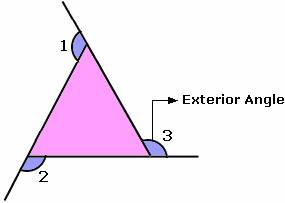
∠1, ∠2, and ∠3 are the exterior angles.
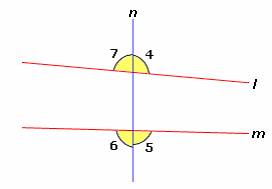
∠4, ∠5, ∠6, and ∠ 7 are the exterior angles.
Solved Example on Exterior Angle
Ques: Identify the pair of exterior angles in the figure.
Choices:
A. 1 and 2
B. 2 and 4
C. 1 and 3
D. 3 and 4
Correct Answer: C
Solution:
Step 1: An Exterior Angle of a polygon is the angle formed when one side is extended to its adjacent sides.
Step 2: From the figure, the angles 1 and 3 are exterior because one side is extended to its adjacent sides.
Step 3: So, 1 and 3 is a pair of exterior angles.
Quick Summary
- The number of exterior angles in a polygon equals the number of sides of the polygon.
- An exterior angle is supplemental to the adjoining interior angle.
- The sum of the measures of exterior angles of a convex polygon is 360°.
- The measure of an exterior angle of a triangle is equal to the sum of its two remote interior angles.
🍎 Teacher Insights
Use visual aids and real-world examples to demonstrate the concept of exterior angles. Emphasize the relationship between exterior and interior angles, and provide ample practice problems to reinforce the calculations.🎓 Prerequisites
- Interior Angles
- Polygons
- Supplementary Angles
- Linear Pairs
Check Your Knowledge
Q1: Which of the following statements is true regarding the exterior angles of a convex polygon?
Q2: If an interior angle of a polygon measures 120 degrees, what is the measure of its corresponding exterior angle?
Frequently Asked Questions
Q: What is the relationship between an exterior angle and its adjacent interior angle?
A: They are supplementary, meaning they add up to 180 degrees.
Q: Does every polygon have exterior angles?
A: Yes, every polygon has exterior angles, one at each vertex.