DISPLACEMENT
Definition Of Displacement
Displacement of an object with respect to an initial point is defined as the vector distance from the initial point to the final point.
More About Displacement
Displacement is a vector quantity as it has both magnitude and direction.
Example of Displacement
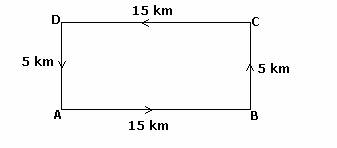
The distance between four different points is shown in the figure. A car starts moving from A, reaches to B, C, D, and finally stops at A. The total distance covered in this case is 40 km, but displacement is 0.
Video Examples: Acceleration and Displacement
Solved Example on Displacement
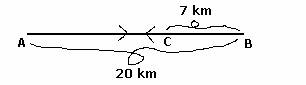
Ques: FBen traveled from A to B. Again he started to travel back from B to A and reached the position C. What was the displacement?
Choices:
A. 13 km
B. 7 km
C. 27 km
D. 20 km
Correct Answer: A
Solution:
Step 1: We have to find the displacement from A to C.
Step 2: Distance between A and B = 20 km.
Step 3: Distance between B and C = 7 km.
Step 4: Distance between A and C = 20 - 7 = 13 km.
Step 5: So, the displacement was 13 km.
Quick Summary
- Displacement is a vector quantity with magnitude and direction.
- Displacement is the change in position of an object.
- Displacement can be zero even if the distance traveled is not zero.
🍎 Teacher Insights
Use real-world examples to illustrate the difference between distance and displacement. Emphasize the vector nature of displacement. Use diagrams and graphs to help students visualize displacement.🎓 Prerequisites
- Vectors
- Distance
- Coordinate Systems
Check Your Knowledge
Q1: A car travels 20 km east and then 20 km west. What is the displacement?
Q2: A person walks 5 m north, 3 m east, 5 m south, and 3 m west. What is their total displacement?
Frequently Asked Questions
Q: What is the difference between displacement and distance?
A: Distance is the total length of the path traveled, while displacement is the shortest distance between the initial and final positions.
Q: Can displacement be zero if an object moves?
A: Yes, if the object returns to its starting point, the displacement is zero.