DISCRETE DATA
Definition Of Discrete Data
A set of data having finite number of values or data points is called Discrete Data.
More About Discrete Data
The opposite of the discrete data i.e. sets of infinite number of values is called Continuous Data
Example of Discrete Data
Number of hours John spent swimming in a week.
This is an example of discrete data as swimming period (finite) of John will be specific.
Video Examples: Discrete Data
Solved Example on Discrete Data
Ques: The table shows the collection of coins by Sandy. Which type of graph is appropriate to display the data in the table?
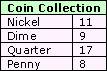
Choices:
A. Bar graph
B. Histogram
C. Line graph
D. Stem-and-leaf plot
Correct Answer: A
Solution:
Step 1: The data given in the table are discrete.
Step 2: Bar graphs are used to represent discrete data.
Step 3: So, a bar graph is appropriate to display the data shown in the table.
Quick Summary
- Discrete data has a finite number of values.
- Discrete data is the opposite of continuous data.
- Bar graphs are commonly used to represent discrete data.
🍎 Teacher Insights
Use real-world examples to illustrate the concept of discrete data. Employ visual aids such as bar graphs and pie charts. Emphasize the importance of choosing the correct graph type for the data.🎓 Prerequisites
- Basic counting
- Understanding of data sets
Check Your Knowledge
Q1: Which of the following is an example of discrete data?
Q2: Which type of graph is most appropriate for displaying discrete data?
Frequently Asked Questions
Q: What is the difference between discrete and continuous data?
A: Discrete data can only take on specific, separate values (e.g., number of coins), while continuous data can take on any value within a range (e.g., height).
Q: Can discrete data be decimals?
A: While discrete data represents countable items, the calculations or results may include decimals (e.g., average number of siblings).