DILATION
Definition Of Dilation
Dilation is a similarity transformation in which a figure is enlarged or reduced using a scale factor ? 0, without altering the center.
More About Dilation
When the scale factor of a dilation is greater than 1, the dilation is an enlargement.
When the scale factor of a dilation is less than 1, the dilation is a reduction.
Example of Dilation
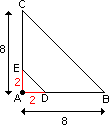
In the figure shown, triangle ADE is enlarged to triangle ABC using a scale factor 4. Here, A is the center of dilation.
Video Examples: Dilation
Solved Example on Dilation
Ques: A'B'C'D' is a dilation of ABCD. Find the scale factor if AB = 2 × A'B'.
Choices:
A. 2
B. 5
C. 0.5
D. 0.2
Correct Answer: C
Solution:
Step 1: A'B'C'D' is a dilation of ABCD.
Step 2: AB = 2 × A'B' implies A'B' = 0.5 × AB
Step 3: So, the scale factor is 0.5.
Quick Summary
- Dilation enlarges or reduces a figure.
- Scale factor determines the size change.
- If scale factor > 1, it's an enlargement.
- If scale factor < 1, it's a reduction.
- The center of dilation remains unchanged.
🍎 Teacher Insights
Use visual aids and interactive software to demonstrate dilation. Emphasize the relationship between the scale factor and the size change. Provide examples with different centers of dilation.🎓 Prerequisites
- Ratio
- Proportion
- Similarity
Check Your Knowledge
Q1: A triangle with vertices A(1, 1), B(2, 1), and C(1, 2) is dilated by a scale factor of 3 with the origin as the center of dilation. What are the coordinates of the dilated triangle A'B'C'?
Q2: If AB = 2 × A'B', where A'B' is a dilation of AB, what is the scale factor?
Frequently Asked Questions
Q: What happens if the scale factor is 1?
A: If the scale factor is 1, the figure remains unchanged.
Q: Can the scale factor be negative?
A: While less common in basic geometry, a negative scale factor represents a dilation combined with a rotation of 180 degrees about the center of dilation.