CORRESPONDING ANGLE CONJECTURE
Definition Of Corresponding Angle Conjecture
If two parallel lines are cut by a transversal, then the Corresponding Angles are congruent.
More About Corresponding Angle Conjecture
If a transversal intersects two lines and the corresponding angles are congruent, then the lines are parallel.
Video Examples: Corresponding Angles
Example of Corresponding Angle Conjecture

In the above figure, CG||DH and AF is the transversal cutting the two parallel lines. The pairs of corresponding angles ∠ABC and ∠BED, ∠CBE and ∠DEF, ∠ABG and ∠BEH, and ∠GBE and ∠HEF are equal.
Solved Example on Corresponding Angle Conjecture
Ques: l and m are parallel lines in the figure. What are the measures of ∠x, ∠y, and ∠z?
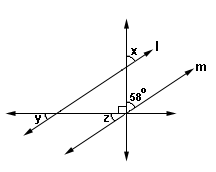
Choices:
A. 60°, 30° and 30°
B. 30°, 30° and 32°
C. 58°, 32° and 32°
D. None of the above
Correct Answer: C
Solution:
Step 1: From the figure, ∠x and 58°, ∠y and ∠z form corresponding angles.
Step 2: ∠x = 58° [Corresponding angles are equal.]
Step 3: ∠z + 90° + 58° = 180°
Step 4: So, ∠z + 148° = 180°
Step 5: ∠z = 180° - 148° = 32°
Step 6: ∠z = ∠y [Corresponding angles are equal.]
Step 7: ∠y = 32°
Quick Summary
- Corresponding angles are formed when a transversal intersects two lines.
- If the two lines are parallel, corresponding angles are congruent.
- If corresponding angles are congruent, the two lines are parallel.
🍎 Teacher Insights
Use visual aids and hands-on activities to demonstrate the concept. Have students draw parallel lines and transversals to identify corresponding angles. Emphasize the 'if and only if' relationship between parallel lines and congruent corresponding angles.🎓 Prerequisites
- Parallel lines
- Transversal
- Angle congruence
- Basic angle types (acute, obtuse, right)
Check Your Knowledge
Q1: If two parallel lines are cut by a transversal, which of the following is true?
Q2: In a diagram where a transversal intersects two lines, ∠1 and ∠5 are corresponding angles. If m∠1 = 70°, and the lines are parallel, what is m∠5?
Frequently Asked Questions
Q: What is a transversal?
A: A transversal is a line that intersects two or more other lines.
Q: Are corresponding angles always congruent?
A: No, corresponding angles are only congruent if the two lines intersected by the transversal are parallel.