CONTINUOUS DATA
Definition Of Continuous Data
The data that is continuous (without breaks) in a selected range is known as Continuous Data.
More About Continuous Data
Continuous data is the opposite of discrete data.
Continuous data will have infinite number of possible values within the selected range.
Line graphs and histograms are used to represent continuous data.
Examples of Continuous Data
The height of a boy over time is an example of continuous data.
Varying temperature from maximum to minimum point on a particular day is a continuous data.
Video Examples: Line Math
Solved Example on Continuous Data
Ques: Which of the figures has the lines P, Q, R, and S converging to the point A?
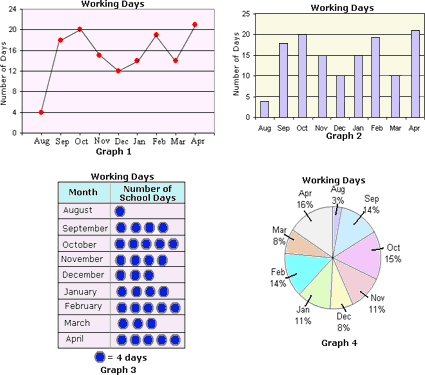
Choices:
A. Graph 1
B. Graph 3
C. Graph 2
D. Graph 4
Correct Answer: A
Solution:
Step 1: Of the four graphs listed, line graph displays continuous data. [The graph that is drawn without any gap in an interval is used to display continuous data.]
Step 2: So, Graph 1 displays continuous data.
Quick Summary
- Continuous data has infinite possible values within a range.
- Line graphs and histograms are used to represent continuous data.
- Examples include height, temperature, and time.
🍎 Teacher Insights
Use real-world examples to illustrate continuous data, such as measuring the height of students or tracking the temperature throughout the day. Emphasize the difference between continuous and discrete data with clear examples and visuals.🎓 Prerequisites
- Basic Algebra
- Understanding of Graphs
Check Your Knowledge
Q1: Which of the following is an example of continuous data?
Q2: What type of graph is best used to represent continuous data?
Frequently Asked Questions
Q: What is the difference between continuous and discrete data?
A: Continuous data can take any value within a range, while discrete data can only take specific, separate values.
Q: Can continuous data be whole numbers?
A: Yes, continuous data can include whole numbers, but it can also include decimals and fractions. The key is that any value within a range is possible.