CONGRUENT TRIANGLES
Definition Of Congruent Triangles
Two triangles are said to be congruent if their corresponding sides and angles are equal.
More About Congruent Triangles
The following congruency tests are used to check the congruency of two triangles:
SAS Congruency Postulate: If two sides and the included angle of one triangle are congruent to two sides and the included angle of another triangle, then the two triangles are congruent.
SSS Congruency Postulate: If three sides of one triangle are congruent to three sides of another triangle, then the two triangles are congruent.
ASA Congruency Postulate: If two angles and the included side of one triangle are congruent to the two angles and the included side of another triangle, then the two triangles are congruent.
SAA Congruency Postulate: If two angles and the non-included side of one triangle is congruent to two angles and the non-included side of another triangle, then the two triangles are congruent.
Video Examples: Introduction to Congruent Triangles
Example of Congruent Triangles
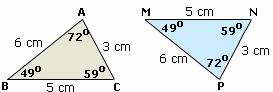
Since all the sides and angles of the triangles ABC and MPN are equal, so triangle ABC is congruent to triangle MPN.
Solved Example on Congruent Triangles
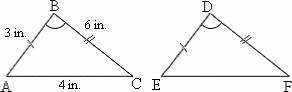
Ques: â–³ABC and â–³EDF are congruent triangles. Find the length of EF.
Choices:
A. 3 in.
B. 4 in.
C. 6 in.
D. 5 in.
Correct Answer: B
Solution:
Step 1: Congruent triangles have congruent corresponding parts (sides and angles).
Step 2: Length of EF = length of AC = 4 in.
Quick Summary
- Congruent triangles have equal corresponding sides and angles.
- SAS, SSS, ASA, and SAA are congruency postulates.
🍎 Teacher Insights
Use visual aids and hands-on activities to demonstrate congruence. Emphasize the importance of correctly identifying corresponding parts.🎓 Prerequisites
- Triangles
- Angles
- Sides
- Basic Geometric Definitions
Check Your Knowledge
Q1: If triangle ABC is congruent to triangle XYZ, and AB = 5, what is the length of XY?
Q2: Which postulate can be used to prove two triangles are congruent if all three sides of one triangle are congruent to the corresponding sides of the other triangle?
Frequently Asked Questions
Q: What does SAS stand for?
A: Side-Angle-Side. It means two sides and the included angle of one triangle are congruent to the corresponding parts of another triangle.
Q: Are similar triangles the same as congruent triangles?
A: No. Similar triangles have the same shape but can be different sizes. Congruent triangles are exactly the same – same shape and same size.