COMPONENTS OF A VECTOR
Definition Of Components Of A Vector
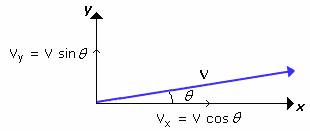
Any two-dimensional vector can be said to have an influence in two different directions. Thus we can say it has two parts. Each of these two parts-one horizontal, and the other, vertical-is known as component.
More About Components of a Vector
The horizontal and vertical components of a vector v are given as |v| cos θ and |v| sin θ respectively, where θ is the angle made by v with positive x-axis in the clockwise direction.
Video Examples: Components of Vectors
Example of Components of a Vector
Solved Example onComponents of a Vector
Ques: Which of the following is the vertical component of the vector v with direction angle 405° and the magnitude ?
?
Choices:
A. 4
B.
C. 8
D.
Correct Answer: A
Solution:
Step 1: The vertical component of v whose direction angle is θ = |v| sin θ
Step 2: = sin 405° [Substitute |v| = , θ = 405°.]
Step 3: = × () = 4.
Quick Summary
- Any 2D vector has influence in two directions.
- Horizontal component: |v| cos θ.
- Vertical component: |v| sin θ, where θ is the angle with the positive x-axis.
🍎 Teacher Insights
Emphasize the relationship between vector components and trigonometric functions. Use visual aids like diagrams and interactive simulations to help students understand the concept.🎓 Prerequisites
- Trigonometry
- Basic Algebra
- Coordinate Geometry
Check Your Knowledge
Q1: A vector has a magnitude of 10 and makes an angle of 30 degrees with the x-axis. What is the horizontal component?
Q2: Which of the following is the vertical component of the vector v with direction angle 405° and the magnitude 8?
Frequently Asked Questions
Q: What are vector components used for?
A: Vector components simplify vector addition, subtraction, and other operations. They allow us to treat vectors as algebraic quantities.
Q: How do I find the components if I only know the vector's endpoints?
A: Subtract the initial point coordinates from the terminal point coordinates to find the component form of the vector. Then, if you want to express them in magnitude and direction, calculate the magnitude and angle as usual.