CANCELLATION
Definition Of Cancellation
The operation of canceling out common factors in both the numerator and the denominator is called Cancellation.
More About Cancellation
When common factors exist on both sides of an equation, canceling can be done.
By adding and subtracting common factors to both sides of an equation, canceling can be done.
Example of Cancellation
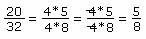
First, the numerator and the denominator are written as a product of their factors. Then the common factors are cancelled.
Video Examples:Multiplying Fractions Using Cancellation
Solved Example on Cancellation
Ques: Solve for the variable in the equation 5a = - 25
Choices:
A. - 20
B. 5
C. - 30
D. - 5
Correct Answer: D
Solution:
Step 1: 5a = - 25 [Original equation.
Step 2: (5a)/5 = - 25/5 [Divide both sides by 5.]
Step 3:a = - 5
Quick Summary
- Cancellation simplifies fractions.
- It involves dividing both numerator and denominator by the same factor.
- It's applicable when common factors exist in both numerator and denominator.
🍎 Teacher Insights
Emphasize the importance of factoring completely before attempting to cancel. Use visual aids to demonstrate the cancellation process.🎓 Prerequisites
- Basic arithmetic operations
- Understanding of factors
- Knowledge of numerator and denominator
Check Your Knowledge
Q1: Simplify the fraction: 6/15
Q2: Simplify the fraction: (4*7) / (2*7)
Frequently Asked Questions
Q: When can I use cancellation?
A: Cancellation can be used when there are common factors in both the numerator and the denominator of a fraction.
Q: What happens if I cancel incorrectly?
A: Incorrect cancellation will lead to an incorrect simplified fraction or solution.