BALANCE
Definition Of Balance
Balance is a state of equilibrium where mass or weight on either side of a measuring device is equal.
An apparatus used to measure mass or weight is called a Balance.
More About Balance
Both the sides of the weighing device have same masses
The heavy end goes down and light end goes up
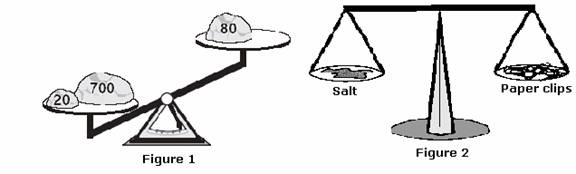
Example of Balance
Here, the weights in figure 1 are not balanced as they are unequal. But in figure 2, the weights on both the pans are same. So, they are balanced.
Solved Example on Balance
Ques: Which sentence is true for the figure shown?
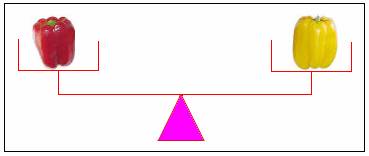
Choices:
A. The yellow pepper weighs more than the red pepper
B. The red pepper weighs less than the yellow pepper
C. The red pepper weighs the same as the yellow pepper
D. The red pepper weighs more than the yellow pepper
Correct Answer: C
Solution:
Step 1: From the figure, it is clear that both the pans are balanced with same weight
Step 2: So, the red pepper weighs the same as the yellow pepper.
Quick Summary
- Balance indicates equal distribution of weight.
- A balance is a tool used to measure weight or mass.
- Balanced objects are in equilibrium; unbalanced objects are not.
🍎 Teacher Insights
Use hands-on activities with real balances and objects to illustrate the concept. Emphasize the difference between mass and weight.🎓 Prerequisites
- Basic understanding of weight
- Familiarity with simple measurement
Check Your Knowledge
Q1: In the image provided, which statement is true regarding the peppers on the balance?
Frequently Asked Questions
Q: What happens if the weights on a balance are unequal?
A: The heavier side will go down, and the lighter side will go up.
Q: Can you use a balance to measure volume?
A: No, a balance measures mass or weight. Volume is measured differently.