ASYMPTOTE
Definition Of Asymptote
Asymptote is a line that a graph gets closer and closer to, but never touches or crosses it.
Examples of Asymptote
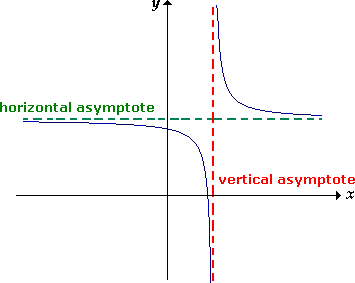
Video Examples: Asymptotes of Rational Functions
Solved Example on Asymptote
Ques: Find the vertical asymptote of the graph of the function  .
.
Choices:
A. x = - 1
B. x = 1
C. x = 0
D. x = 2
Correct Answer: B
Solution:
Step 1: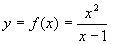 is clearly discontinuous at x = 1.
Step 2:  If then the line x = c, is the vertical asymptote. [Definition.]
Step 3:  [For the vertical asymptote.]
Step 4:  [Numerator is positive, denominator is a very small positive number.]
Step 5:  [For the vertical asymptote.]
Step 6: 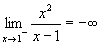 [Numerator is positive, denominator is a very small negative number.]
Step 7: So, x = 1 is the vertical asymptote of the curve f (x).
Quick Summary
- Asymptotes can be horizontal, vertical, or oblique.
- Vertical asymptotes occur where the function is undefined (e.g., denominator is zero).
- Horizontal asymptotes describe the function's behavior as x approaches positive or negative infinity.
- Oblique asymptotes occur when the degree of the numerator is one greater than the degree of the denominator in a rational function.
🍎 Teacher Insights
Emphasize the graphical interpretation of asymptotes. Use graphing calculators or software to visualize the behavior of functions near asymptotes. Provide examples of functions with different types of asymptotes. Stress the importance of limits in determining asymptotes.🎓 Prerequisites
- Limits
- Functions
- Rational Expressions
- Graphing
Check Your Knowledge
Q1: Which of the following functions has a vertical asymptote at x = 2?
Q2: What is the horizontal asymptote of f(x) = (2x^2 + 1)/(x^2 - 3)?
Frequently Asked Questions
Q: Can a function cross an asymptote?
A: A function can cross a horizontal or oblique asymptote, but it cannot cross a vertical asymptote.
Q: How do I find vertical asymptotes?
A: Vertical asymptotes typically occur where the denominator of a rational function equals zero. Check the limits as x approaches these values.
Q: How do I find horizontal asymptotes?
A: Horizontal asymptotes are found by evaluating the limit of the function as x approaches positive and negative infinity.