AEA CONJECTURE
Definition Of AEA (Alternate Exterior Angle) Conjecture
AEA (Alternate Exterior Angle) Conjecture states that if two parallel lines are cut by a transversal, then the alternate exterior angles are congruent.
More About AEA Conjecture
Two pairs of alternate exterior angles are formed when two parallel lines are cut by a transversal
Examples of AEA Conjecture
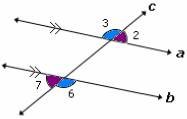
Here a and b are two parallel lines and c is the transversal.∠2, ∠7 and ∠3, ∠6 are pairs of alternate exterior angles. According to AEA (alternate exterior angle) conjecture ∠2 and ∠7 are congruent, and ∠3 and ∠6 are congruent and can be represented as ∠2≅∠7 and∠3≅∠6.
Video Examples: Alternate Exterior Angle Theorem
Solved Example on AEA Conjecture
Ques:
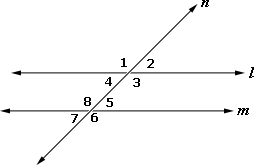
The lines l and m are parallel in the figure. Which of the angles satisfies the AEA conjecture?
Choices:
A. ∠5 and ∠6
B. ∠1 and ∠6
C. ∠3 and ∠8
D. ∠1 and ∠4
Correct Answer: B
Solution:
Step 1: Only alternate exterior angles of parallel lines satisfy the AEA conjecture.
Step 2: Angles formed on the outside of two parallel lines and on the opposite of transversal are called alternate exterior angles of the parallel lines.
Step 3: The alternate exterior angles of the figure are ∠1 and ∠6, ∠2 and ∠7.
Step 4: Here, ∠1 and ∠6 are alternate exterior angles and hence congruent to each other.
Step 5: So, ∠1 and ∠6 satisfy the AEA conjecture.
Quick Summary
- Alternate exterior angles are formed on the outside of two lines and on opposite sides of the transversal.
- If the lines are parallel, alternate exterior angles are congruent.
🍎 Teacher Insights
Use visual aids and hands-on activities to help students distinguish between different types of angles formed by transversals.🎓 Prerequisites
- Parallel lines
- Transversals
- Angles
- Congruence
Check Your Knowledge
Q1: If two parallel lines are cut by a transversal, and one alternate exterior angle measures 60 degrees, what is the measure of the other alternate exterior angle?
Q2: Lines 'a' and 'b' are cut by transversal 't'. Angle 1 and Angle 8 are alternate exterior angles. If Angle 1 = 100 degrees and Angle 8 = 80 degrees, are lines 'a' and 'b' parallel?
Frequently Asked Questions
Q: What are alternate exterior angles?
A: Alternate exterior angles are pairs of angles that lie on the outside of two lines and on opposite sides of a transversal.
Q: When are alternate exterior angles congruent?
A: Alternate exterior angles are congruent if and only if the two lines cut by the transversal are parallel.